 Yazhini Manimudi
You may not remember wearing or even coming across a perfume with the L’Oreal label on it. But chances are you have worn a L’Oreal fragrance without realizing it. The beauty conglomerate owns a number of fragrance companies and niche luxury brand Creed is set to be one of them.
Creed, founded in 1760 to cater to royalty, is known for its high end fragrances like Aventus, Green Irish Tweed, Viking, Carmina, Queen of Silk, Eladaria, and more. Creed has been worn by the most influential members of society like Empress Eugenie of France and her husband Napoleon III, Winston Churchill, Grace Kelly, Michelle Obama, and Kate Middleton.
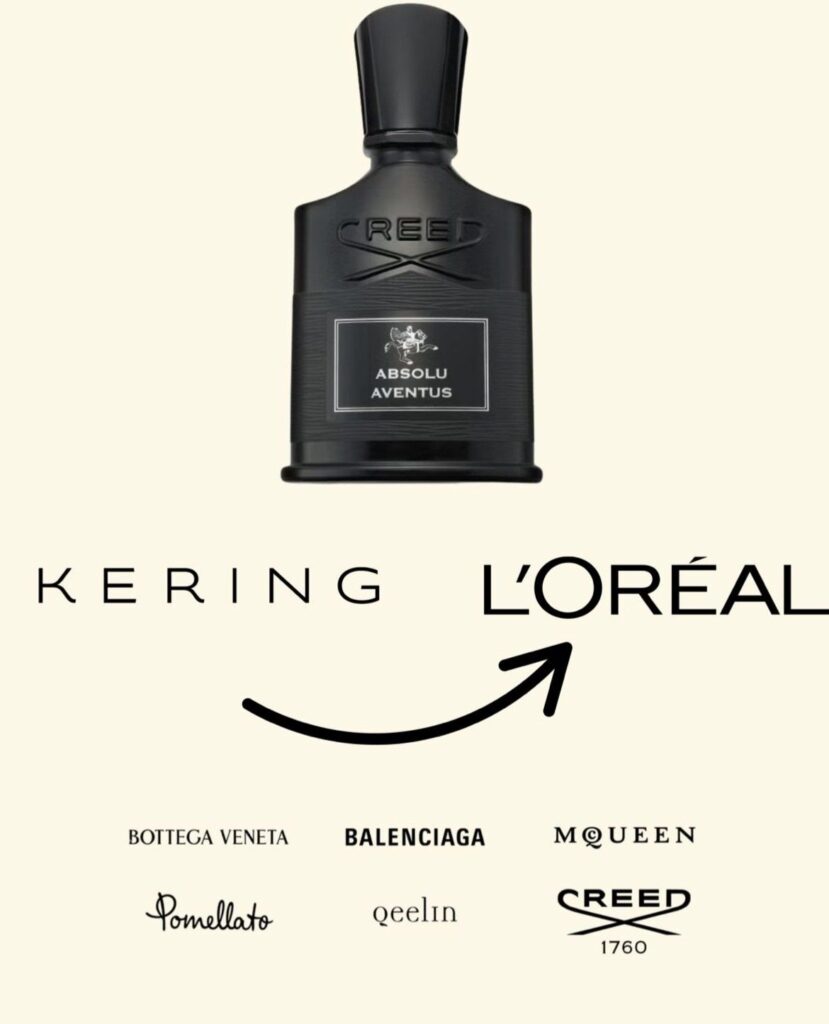
Creed was previously owned by Kering and came under Kering Beauté, along with Bottega Veneta, Balenciaga, McQueen. Kering only purchased Creed in 2023 for a whopping $ 3.5 Billion to reduce their dependence on Gucci, one of their couture houses.
With Kering in debt, its new CEO Luca de Meo who took the position this September, is moving their focus towards their core fashion brands. Kering has sold the entirety of Kering Beauté for $ 4.7 Billion. This includes the Creed house and the exclusive rights to develop beauty and fragrance products for 50 years for beauty brands under Kering, namely Balenciaga, and Bottega Veneta.
This deal with Loreal will significantly help Kering with their net debt of € 9.5 Billion (as of June, 2025) and € 6 Billion euros in long-term lease liabilities.
Mergers and acquisitions can be controversial in beauty communities online. People often complain about reformulation and drops in quality and dissatisfaction with changes in the brand’s offerings. This is often the case with more niche and niche-luxury houses when they are acquired by the beauty behemoths like L’Oreal, LVMH, and Estée Lauder.
It is disappointing when just three big conglomerates own everything in the beauty space from traditional family-run houses like Guerlain (LVMH, since 1994) to niche fan favorites like Le Labo (Estée Lauder, since 2014). Monopolies aren’t good for anyone–
- Absolute power to determine prices, leading to unstoppable price increases and consumer exploitation.
- Reduction and eventual elimination of competition.
- Opportunities for creativity can be nipped at the bud with fewer businesses in the playing field.
- Prevention of the creation of legacy brands as every small brand is acquired right as it begins to develop.
- Danger of homogenous and less diverse options as monopoly brands lose incentive to invest money into research and innovation.
- Illusion of choice as no matter which brand you choose, you will be giving your hard-earned cash to a small handful of companies. It becomes nearly impossible to express your dissatisfaction with a brand if every other option available in the market has the same owner.
- Repercussion of mismanagement is much higher when it impacts multiple brands rather than one or two. The fallout would hurt not just the tens of brands they own, and the industry in which they operate, but the economy itself due to the sheer size of such businesses.
- Monopolies increase the barriers for entry for new businesses by taking full control of supply chains, essential equipment, raw material suppliers, and even the government whose approval businesses need to operate. Want to start your own perfume company? Tough luck.
- Disappearance of smaller brands. Conglomerates acquire smaller brands because they are successful, but not every brand under the parent company’s management will get equal attention or resources. Any brand that isn’t bringing the absolute highest value to shareholders is in danger of being axed. A brand doesn’t even have to cause losses to be wiped out, only perform slightly below expectations.
- Mergers and acquisitions come with a lot of job losses. This affects the economy at large for sure. But it also means the loss of talent in the industry. Big perfumers will keep their job or easily find a good position in a different company within the industry. But those who are starting out may never be able to return to the industry again, their potential and their creativity that could’ve given us the next Aventus or Sauvage disappearing forever.
Is it over for your favourite Creed perfumes?
The short answer is probably not. There is no reason to give in to hysteria…yet.
None of us can predict the future. The assumption is that no company buys a profitable venture to run it into the ground when they just want to make money off of it.
We have seen perfumes become less interesting when a fragrance house is bought by a bigger company. Profit becomes the most important goal and fragrances are made to be appealing to the highest number of people. To be loved by everyone, a product must lose anything that makes it remotely different or special as risky elements could mean a slight drop in already massive profit projections.
Creed, so beloved and enjoying a massive consumer base, is most probably not in danger. Your favourite fragrances will remain. Don’t fret over it. At least not yet.


 Yazhini Manimudi


 Sowmya Gibish

